

How LOLcats Threaten the World Economy
Share and Enjoy
Everyone loves a LOLcat. Pictures and videos of cats brighten our day and make us laugh. But as one could reasonably guess, the time we spend constantly scrolling through feline entertainment content may significantly affect our job performance, as well as the global economy as a whole. Research shows that viewing cat videos, which form a part of a general excess of web entertainment content, can have serious effects on a company’s productivity. Employees take too much time looking for data online, getting sidetracked and distracted by entertainment that corrodes their attention span. In the long run, this costs companies billions of dollars.
Research Methodology
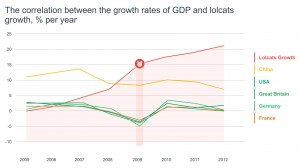
Researchers at LikeHack compared the annual rate of GDP (gross domestic product) growth in some leading economies with the number of LOLcats on the web. (Note that here “LOLcats” stand for all useless ephemeral entertainment, like Instagram photos, irrelevant status updates, TMI tweets by celebrities etc.) According to data collected from about 3 million user accounts, the average coefficient of useless content for a given web surfer’s attention engagement is about 30 percent. This number was then multiplied by the overall growth of information shared over social networks to yield the number of “LOLcats”.
Causes of Information Overload
The bad news is, LOLcats are multiplying and clogging up our social networks at ever-increasing rates. This has a direct effect on the global economy. 2009 registered the biggest jump in LOLcat entertainment; it also saw the unraveling of the global financial crisis.
China is facing the same problem. Before 2006, Chinese companies were growing at a significant pace. Soon after, however, the Chinese economy was paralyzed by a wave of useless content during a period of active growth in the number of social networks in China, which were coming into regular use by company employees. The correlation between the growth rate of China’s GDP and the proliferation of LOLcats on Chinese social networks is -0.8, which seems to suggest that LOLcats took a serious bite out of the Chinese economy.
Gone are the days when one could surf the web without being assaulted from all sides for useless content. The leading world economies are also the most inundated. What can be done to solve this?
In 2010, Facebook introduced a filter for its newsfeed, which reduced the amount of useless content its users were subjected too. This is reflected in the chart. The pace of LOLcat growth was slowed, and the developed countries began to come out of the recession.
To Sum Up
Many companies today realize that web information overload has impaired their economic performance. Every day, their workers waste time scrolling through a cluttered web on the company dime. 52% of American workers say that the quality of their work suffers because of information overload and their inability to find the right information quickly and without distractions. This reduces their productivity, and, as a result, impairs worker efficiency throughout the country and the world. According to research done in 2011, American companies lose about 650 billion dollars annually through unproductive web surfing.
Information overload is a serious problem that should not be underestimated. Content curation services and filters offer a real solution.
Related Posts
 Humanrithm: why data without people is not enough.
 7 Tips From Professional Writers on How to Make Your Content More Readable
 The 6 Biggest Milestones For Getting Started With A New Blog
 5 Hot Tools for a Corporate Twitter account
 TMI – the tag of the crazy world
![Siberia rocks! Jane Smorodnikova and LikeHack raise seed funding [goaleurope.com]](../blog/wp-content/uploads/2012/10/siberia-150x150.jpg) Siberia rocks! Jane Smorodnikova and LikeHack raise seed funding [goaleurope.com]
Siberia rocks! Jane Smorodnikova and LikeHack raise seed funding [goaleurope.com]


